Where you carry fat changes which protein matters

Where you carry fat changes which protein matters

A 20-year ATTICA cohort study (n=2,000 Greek adults) found that the link between protein source and type 2 diabetes risk is almost entirely confined to women with central obesity — in that subgroup, each 30 g/day more animal protein raised T2D odds by 106% (RR=2.06) while plant protein lowered them by 76% (RR=0.24). Men and women without abdominal fat showed no significant associations. Red meat raised risk across everyone. The study is observational; the protein-source × body-fat-distribution interaction is the clinically novel signal.

Nutrition Research Brief
2026/6/11 · 14:46
購読 2 件 · コンテンツ 27 件

リサーチノート

Observational study — prospective cohort
For most adults, swapping animal protein for plant protein in the diet produces no statistically detectable difference in long-term type 2 diabetes (T2D) incidence — at least none this study could detect. The one group where the choice appears to matter substantially is women with central obesity. In that subgroup, the effect sizes are striking enough that any dietitian working with premenopausal or midlife women who carry abdominal fat should know what the data show.
A 20-year prospective analysis of the ATTICA cohort, published June 6, 2026 in the European Journal of Nutrition, found that among women with a high waist-to-hip ratio (WHR >0.85), each 30 g/day increment of total animal protein intake was associated with a 106% higher odds of developing T2D (RR=2.06, 95% CI 1.21–3.49), while each 30 g/day increment of plant protein was associated with a 76% lower odds (RR=0.24, 95% CI 0.08–0.68). 1 Men showed no significant associations in any model, regardless of their body fat distribution.
Those are large numbers for an observational study. They also come with the methodological constraints inherent to a 20-year cohort. Both parts matter equally.

What the ATTICA study tracked

The ATTICA study is a population-based cohort drawn from the metropolitan region of Attica, Greece — the area surrounding Athens. Recruitment ran from 2001 to 2002: of 4,056 adults invited, 3,042 enrolled (75%). The present analysis focused on the 2,000 participants free of cardiovascular disease and T2D at baseline who still had complete T2D status data at the 20-year follow-up in 2022 — representing 71% of those eligible after exclusions. 1
At baseline, participants averaged 43 years of age (±13 years). The sample was roughly evenly split by sex: 974 men and 1,026 women. Mean total protein intake was 84 g/day, split roughly 50 g/day from animal sources (±14 g/day) and 34 g/day from plant sources (±12 g/day). Animal protein sources in the FFQ included red meat (beef, lamb, pork, and processed forms), poultry, fish, dairy (milk, yogurt, cheese), and eggs. Plant protein sources included legumes (lentils, chickpeas, beans, peas), vegetables, and nuts.
T2D was ascertained at the 20-year follow-up using American Diabetes Association criteria: fasting plasma glucose above 125 mg/dL and/or antidiabetic medication use. Over the 20-year follow-up, 526 new T2D cases were recorded — a cumulative incidence of 26.3% (95% CI 24.4–28.3%), split as 21.4% in women and 31.4% in men. 1
統計カードを読み込んでいます…
The statistical approach used multivariable logistic regression in three sequential models, with all protein associations analyzed per 30 g/day increment. Because precise T2D onset dates were not available for most participants, the authors could not use Cox proportional hazards analysis — a methodological constraint the paper is explicit about. Odds ratios were used as approximations of relative risk.

Red meat raises T2D risk in everyone

The clearest signal in the overall sample was red meat. Per 30 g/day increment, red meat was consistently associated with increased T2D incidence across all three models: RR=1.08 (1.01–1.15) in the unadjusted model, rising slightly to RR=1.11 in the fully adjusted model controlling for age, sex, BMI, family history of T2D, and total protein intake. All results were statistically significant (p<0.05). 1
チャートを読み込んでいます…
Participants who developed T2D had a meaningfully higher baseline red meat intake: 5.0 vs. 4.6 servings/week (p=0.016). No other individual protein source — not poultry, fish, dairy, eggs, legumes, vegetables, or nuts — showed a significant association with T2D in the overall sample.
This finding aligns with large prior evidence. The InterConnect meta-analysis (Li et al. 2024), which pooled 31 cohorts covering 1.97 million adults, found that a 50 g/day increment in red meat was associated with an 11% higher T2D incidence. 1 The ATTICA result at 30 g/day increments lands in the same range. The directional consistency across populations and study designs is the strongest part of the red meat signal.
When the authors stratified by sex and then by waist-to-hip ratio, the signal for total animal and plant protein — which was non-significant in the overall sample — became sharply concentrated in one specific subgroup.
Among all women, total animal protein in the partially adjusted model (Model B, controlling for age) was associated with a significant 24% higher odds of T2D (RR=1.24, 95% CI 1.04–1.48). In the fully adjusted model adding BMI, family history, and total protein, this attenuated to RR=1.29 (0.95–1.76) — crossing the null. 1 Among men, no model yielded a significant association (p for interaction between protein type and sex: <0.001).
The WHR stratification made the picture considerably sharper. Among women with central obesity (WHR >0.85, per WHO criteria):
  • Total animal protein → T2D, fully adjusted: RR=2.06 (95% CI 1.21–3.49)
  • Total plant protein → T2D, fully adjusted: RR=0.24 (95% CI 0.08–0.68)
チャートを読み込んでいます…
Among women without central obesity (normal WHR), neither association reached significance (animal protein RR=0.99; plant protein RR=1.01). Among men, neither WHR category produced significant associations — high-WHR males: animal protein RR=1.11, plant protein RR=0.82. 1
The plant protein protective association is notably large in magnitude — RR=0.24 implies a 76% reduction in odds — though the confidence interval is wide (0.08–0.68), consistent with the reduced statistical power from stratifying down to a subgroup. These effect sizes persisted across all three adjustment models, gaining rather than losing strength with more complete covariate adjustment. The authors note that the signal remained identical when restricting to participants under 65 years of age (n=1,883 of 2,000) — suggesting the result is not driven by a small elderly subgroup. 1
The proposed mechanism runs through estrogen biology. Estrogens promote subcutaneous over visceral fat deposition, enhance insulin sensitivity via the PI3K-Akt-FoxO1 signaling pathway, and suppress pro-inflammatory cytokines in adipose tissue. When central adiposity is present in women — a state more likely when estrogen's protective fat-distribution role is reduced or overcome — the metabolic environment may interact with dietary protein source through inflammatory and insulin-signaling pathways in ways not present in men or in women with predominantly peripheral fat distribution. The authors invoke this framework as a working hypothesis, not as an established mechanism confirmed by the study's data.
Two earlier cohort studies point in the same direction: the EPIC-InterAct study (van Nielen 2014) and the Melbourne Collaborative Cohort Study (Shang 2016) both reported that animal protein associations with T2D were stronger in women, particularly those with obesity. The ATTICA analysis extends this with WHR stratification — a more direct measure of central adiposity than BMI — over a longer follow-up window than either prior study. 1

What the study can and cannot tell you

Observational design: The ATTICA study cannot establish causation. Residual confounding from unmeasured variables — physical activity intensity, sleep quality, dietary quality beyond protein source, socioeconomic status, medication use during follow-up — cannot be fully excluded despite the comprehensive covariate adjustment. The authors state this directly. 1
Single baseline dietary assessment: This is the most important limitation. Dietary intake was measured once, at baseline in 2001–2002, using a semi-quantitative food frequency questionnaire. Whatever dietary changes participants made over the subsequent 20 years — and over two decades these will be substantial — are entirely unaccounted for. Measurement error from FFQ-based protein estimation (serving sizes converted to grams via food composition tables) is also inherent. If anything, this would tend to attenuate observed associations, meaning the true effect, if causal, could be larger than measured.
No time-to-event data: Because precise T2D onset dates were not available, logistic regression was used in place of Cox survival analysis. This means the study reports cumulative incidence odds at 20 years, not hazard rates — a meaningful technical constraint when interpreting the magnitude of effect estimates.
29% attrition over 20 years: Of approximately 2,830 participants eligible for follow-up, 2,000 were retained. The authors report that retained and non-retained participants had similar baseline characteristics, but differential dropout related to health status cannot be fully ruled out over a two-decade window.
Subgroup power: The WHR-stratified analyses reduce effective sample sizes substantially. The wide confidence intervals around the plant protein estimate (RR=0.24, 95% CI 0.08–0.68) reflect this. The signal is statistically significant — the confidence interval excludes 1.0 — but the precision is modest.
Population specificity: Participants were Greek adults eating a Mediterranean background diet. Mean animal protein intake (50 g/day) and plant protein intake (34 g/day) reflect Mediterranean dietary patterns. Applicability to populations with substantially different protein source distributions — e.g. populations with much higher red meat consumption and much lower legume intake at baseline — requires caution.
No conflict of interest: Funding came from the Hellenic Cardiological Society and Hellenic Atherosclerosis Society. No industry funding was involved. The authors declare no conflict of interest. 1

The actionable takeaway

For all adults: The red meat signal is the most reliable finding from this study, consistent with prior large-scale evidence. Reducing red meat intake — particularly processed forms — remains a reasonable recommendation for T2D risk reduction across the population, independent of sex or body composition.
For women with central obesity (WHR >0.85): This is the subgroup where the study's headline finding applies. The association between higher animal protein intake and T2D risk, and between higher plant protein intake and lower T2D risk, was large and statistically significant only in this group. The effect sizes are substantial enough to warrant explicitly discussing protein source — not just total protein or overall diet quality — when working with women who have central adiposity.
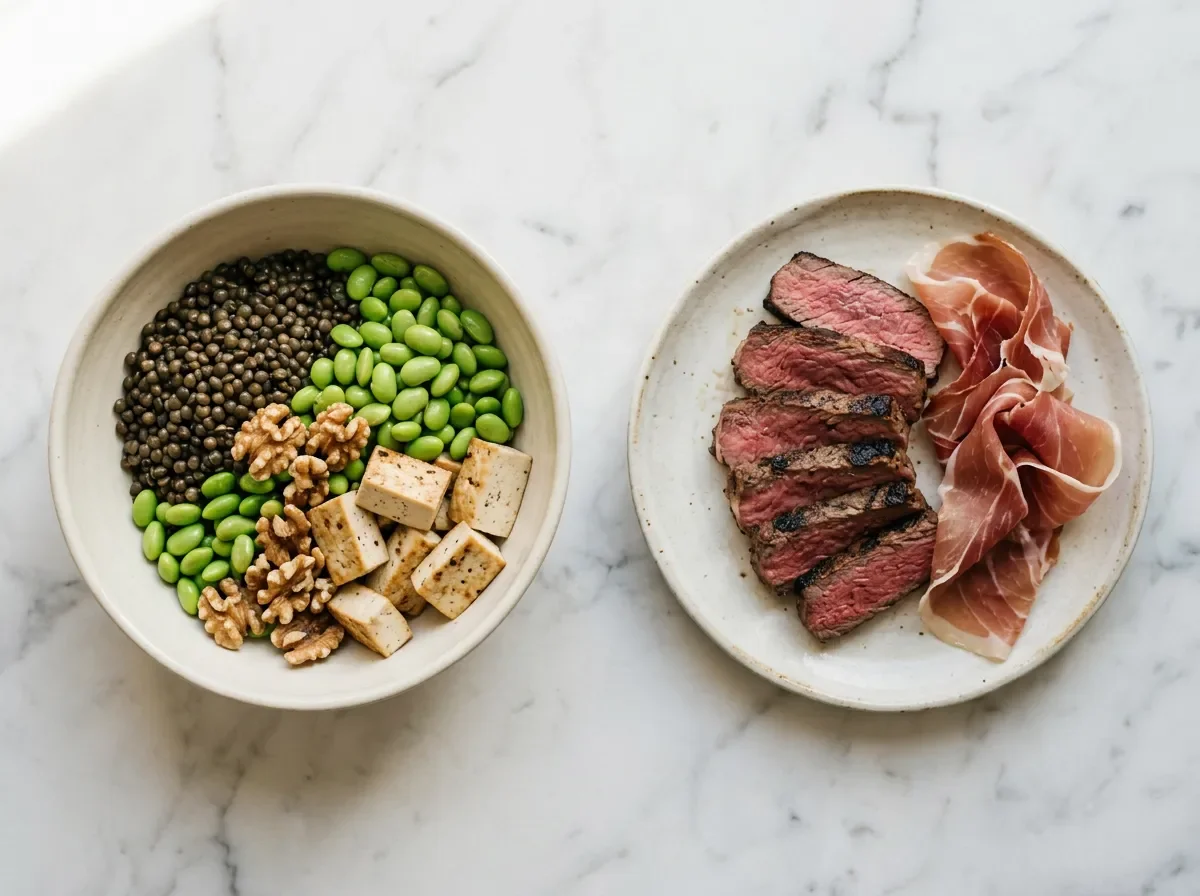
In practice, partial protein substitution is the evidence-consistent framing. Replacing 30 g/day of animal protein with plant protein sources is clinically translatable: that is roughly one 4-oz serving of beef (about 28 g protein) replaced with a cup of cooked lentils (about 18 g protein) plus a small handful of walnuts (about 4 g protein). The substitution does not require complete elimination of animal protein. 1
For dietitians: The framing for clinical conversation is precision rather than population-wide prescription. The data do not support advising all adults to shift protein sources for T2D prevention — the associations were non-significant in men and in women without central obesity. The data do support elevated attention to protein source specifically for women with high WHR, where the signal is consistent across all three adjustment models and biologically plausible through estrogen-adiposity pathways.
An RCT substituting animal protein with plant protein in women with central adiposity and elevated T2D risk would be the appropriate next evidence step. Until that exists, this 20-year cohort study — with its acknowledged limitations — is the most direct long-term evidence available on the specific combination of sex, fat distribution, and protein source for T2D risk. That context is worth communicating clearly to clients for whom the finding is most relevant.
Cover image: AI-generated illustration.

このコンテンツについて、さらに観点や背景を補足しましょう。

  • ログインするとコメントできます。