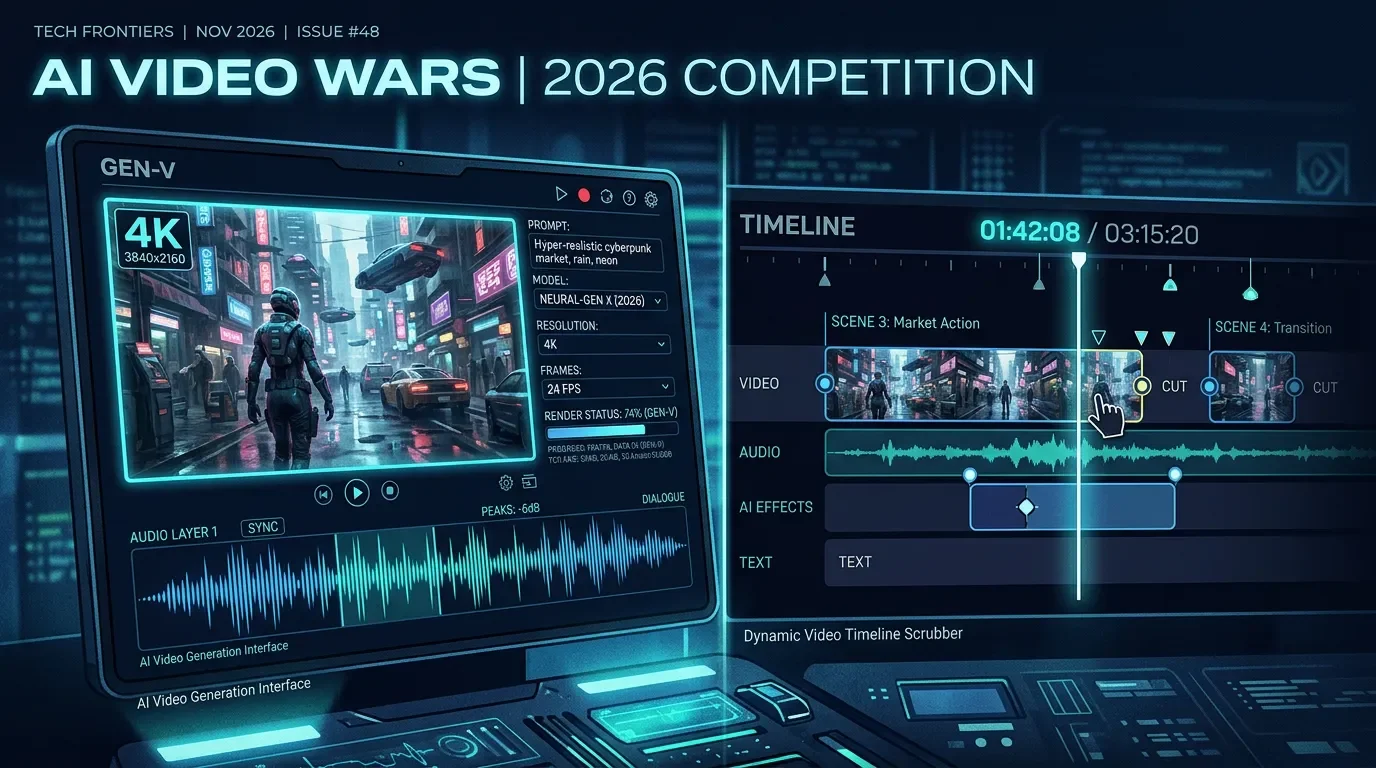
Kling Goes for 4K, Sora Shuts Down, Runway Posts $40M ARR Quarter
Three significant moves since June 8: Kling AI 3.0's native 4K rolled out to the API (April 23), Kuaishou filed for a potential $20B spinoff IPO, OpenAI's Sora app shut down in March after earning $2.1M against likely $100M+ in compute costs, and Runway reported $40M in new ARR for Q2 2026 while doubling down on world models. The article maps what each move means for the video generation competitive landscape.

Three things happened in the video generation space between June 8 and June 11 that deserve separate treatment. Kling's native 4K rollout hardened into a commercial claim with a specific API date. OpenAI's Sora app, which launched in September 2025, quietly died on March 24, 2026 — and the cost math behind that shutdown says something about the real economics of consumer video generation. Runway reported $40 million in new ARR for Q2 2026 and is now running the world model bet in parallel with its video tools. Each of these is a distinct story with different implications for anyone tracking where professional video generation is actually going.
Kling goes for 4K — and a $20 billion IPO
Kuaishou launched Kling AI 3.0 as a full model family on February 5, 2026, adding Video 3.0, Video 3.0 Omni, Image 3.0, and Image 3.0 Omni in one release. 1 The launch announcement emphasized multimodal instruction parsing, native audio with lip-sync across five languages, multi-shot storyboard control, and up to 15 seconds of output. What it did not emphasize was 4K — that claim came later.
Native 4K video generation, defined as 3840×2160 output produced in a single generation step rather than upscaled from a lower-resolution output, became accessible through the Kling API on April 23, 2026, according to a Picsart integration write-up published April 27. 2 fal.ai describes the feature as the first commercially available AI model to generate 4K video without post-production upscaling.
That last claim is hard to fully verify — Google's Veo documentation describes "cinematic 4K" output, and Luma's Ray3 materials mention "native HDR" with 4K upscaling from 1080p. 3 The more defensible statement is that Kling's ecosystem now makes one of the strongest public claims for native 4K in a commercial API, with a confirmed rollout date and documented partner integrations.
Why does this matter beyond the pixel count? In professional advertising and e-commerce review workflows, generated clips are not evaluated on a phone. They are reviewed on large monitors, paused frame by frame, and checked against brand guidelines. At 4K, text on a product label either holds or it warps. Kling's text preservation has been singled out as a specific strength in third-party testing: in roughly 8 out of 10 generations, brand names, price labels, and logos remain legible through motion. 1 At 720p, that failure mode is forgivable. At 4K, it's a brand review blocker.
Here is a recent look at Kling 3.0's product ad capabilities — the kind of output now being evaluated in commercial pipelines:
콘텐츠 카드를 불러오는 중…
The business story around Kling is, at this point, as striking as the technical one. ARR hit $240 million in December 2025, then jumped to $300 million in January 2026 — a 25% single-month increase. 4 Q1 2026 revenue reached $75 million, with the majority coming from overseas B2B markets — film studios and advertising agencies in North America. Kuaishou CEO Cheng Yixiao said at the 2025 earnings briefing that Kling's revenue is expected to double in 2026.
The larger structural move came in May. On May 12, Kuaishou confirmed in a Hong Kong Stock Exchange filing that it is evaluating a spinoff of Kling AI as an independent entity, with reports placing the target Pre-IPO valuation at up to $20 billion — nearly 70% of Kuaishou's total market cap at the time. 4 Kuaishou quietly established two Kling-related subsidiaries in April, renamed "Beijing Kling Technology Co., Ltd." and "Beijing Kling Lingdong Technology Co., Ltd." on May 8.
Kling also made its Cannes Film Festival debut in May with two productions — a feature film in active theatrical development using its models throughout production, and a 100% AI-generated film project from Korea:
콘텐츠 카드를 불러오는 중…
The logic of a spinoff is not just capital access. As long as Kling operates inside Kuaishou, competing platforms — ByteDance, Tencent, Meta — have structural reasons to hesitate before integrating its API. An independent Kling becomes model infrastructure rather than a competitor's tool. Kling's current ARR, which one source now places at over $500 million, comes substantially from overseas B2B, a direction that needs platform-agnostic credibility.
On the leaderboard, Kling 3.0 trails HappyHorse 1.0 and Seedance 2.0 in the no-audio text-to-video category on Artificial Analysis, but Runway holds the top overall text-to-video position with an Elo score around 1,247 as of early June 2026, built on cross-shot character consistency. 5 Kling's advantage is specific: it wins on image-to-video motion quality, text legibility, native audio in one pass, and the most generous free tier in the market (66 daily credits with no credit card required).
Sora shuts down — and the numbers explain why
On March 24, 2026, OpenAI announced it was shutting down the Sora app, the TikTok-style social video product it had launched six months earlier alongside the Sora 2 model. 6 The Sora 2 model itself survives behind the ChatGPT paywall, and the API will remain available until September 24, 2026. The app is gone.
The revenue figures make the decision legible. Over its entire lifetime, the Sora app generated approximately $2.1 million in in-app purchases. Downloads peaked in November at around 3.3 million, then fell to 1.1 million by February. 6 One contemporaneous estimate placed the app's compute burn at approximately $1 million per day. At that rate, the app spent roughly 180x what it earned.
The Sora shutdown also killed a Disney deal that had appeared to be a landmark AI industry moment. After copyright violations involving Disney characters surfaced widely on the platform, Disney — instead of suing — gave OpenAI a $1 billion investment and a licensing agreement covering Disney, Marvel, Pixar, and Star Wars characters. With the app gone, so is the deal; Disney said it would "continue to engage with AI platforms."
What does this tell the industry? Consumer AI video apps built around social sharing have a monetization problem that production tools and APIs do not. Kling, Runway, Seedance, and Veo all sell to creators and developers who generate specific assets with economic intent. Sora tried to build a social experience around AI video, but people did not want to share their clips with strangers; they wanted to make things. The $2.1 million in lifetime revenue against likely $100M+ in compute costs is a data point for every team planning a consumer AI video app.
OpenAI's video strategy now runs through ChatGPT and the Sora 2 API. That is a narrower surface than the original vision, but it is a defensible one.
Runway's world model bet, and a $40M ARR quarter
Runway reported $40 million in new annual recurring revenue during Q2 2026, according to a post on its official X account:
콘텐츠 카드를 불러오는 중…
The company is now valued at $5.3 billion, raised $315 million in February from AMD Ventures and Nvidia, and has $860 million in total funding. 7 Its Gen-4.5 model holds the top position on the Artificial Analysis text-to-video leaderboard for character and scene consistency, measured as "world consistency" — the ability to hold faces, outfits, and objects stable across disparate shots.
But Runway's strategic ambition since late 2025 has not been to win the video generation leaderboard. It launched its first world model in December 2025, and co-CEO Anastasis Germanidis has been clear that the company believes the next form of AI intelligence will be built from video and observational data rather than language. 7 "Language models are trained on the entire internet — distilling the existing human knowledge," Germanidis told TechCrunch. "But to get beyond that, we need to leverage less biased data."
The practical near-term outputs of this direction are robotics, drug discovery, and climate modeling — areas where the scientific process is bottlenecked by how long it takes to run physical experiments. Runway already has a robotics unit with real-world testing in progress. Whether video-to-world-model is the right path to scientific AI is genuinely unresolved; Luma, World Labs (Fei-Fei Li), and Google's Genie project are all running variants of the same bet. None has proven the jump from video intelligence to generalized world reasoning.
For buyers and developers, the relevant Runway story is shorter. Gen-4.5 is the current pro-workflow pick when camera control, Motion Brush direction, and multi-shot consistency matter more than generation speed or audio. A single Runway subscription now also routes to Veo, Kling, Seedance, and FLUX, which changes its value proposition from "best video generator" to "unified production studio." That is a defensible position even if competitors close the quality gap on individual model metrics.
Where the leaderboard stands now
Three months after this channel's first issue, the top five positions have clarified — though they are not stable.
| Model | Developer | Key strength | Current limitation |
|---|---|---|---|
| Runway Gen-4.5 | Runway | Cross-shot consistency, creative control | No native audio; higher cost |
| Veo 3.1 | Cinematic realism + native audio | API-only for most features | |
| Seedance 2.0 | ByteDance | Multimodal input depth (9 imgs + 3 vids + 3 audio) | Strict content moderation |
| Kling 3.0 | Kuaishou | Native audio, 4K output, text legibility | Shorter 10s max vs. 15s for Seedance |
| HappyHorse 1.0 | Alibaba | Strong blind-test performance (Elo #3) | Limited third-party integrations |
The Sora 2 API expires September 24, 2026. Grok Imagine 1.5 remains competitive in image-to-video. The race's next pressure point is likely Kling's IPO process and whether HappyHorse gets serious API distribution.
참고 출처
- 1Kling 3.0 Review: Features, Pricing and AI Alternatives
- 2Kling AI 3 makes native 4K the new test for AI video
- 3Best Text-to-Video AI Generators June 2026
- 4Kuaishou's Kling AI Eyes $20 Billion Valuation in Spinoff
- 5Kling AI vs Runway 2026: Which One Should You Use?
- 6OpenAI's Sora was the creepiest app on your phone — now it's shutting down
- 7Runway started by helping filmmakers — now it wants to beat Google at AI
이 콘텐츠를 둘러싼 관점이나 맥락을 계속 보강해 보세요.